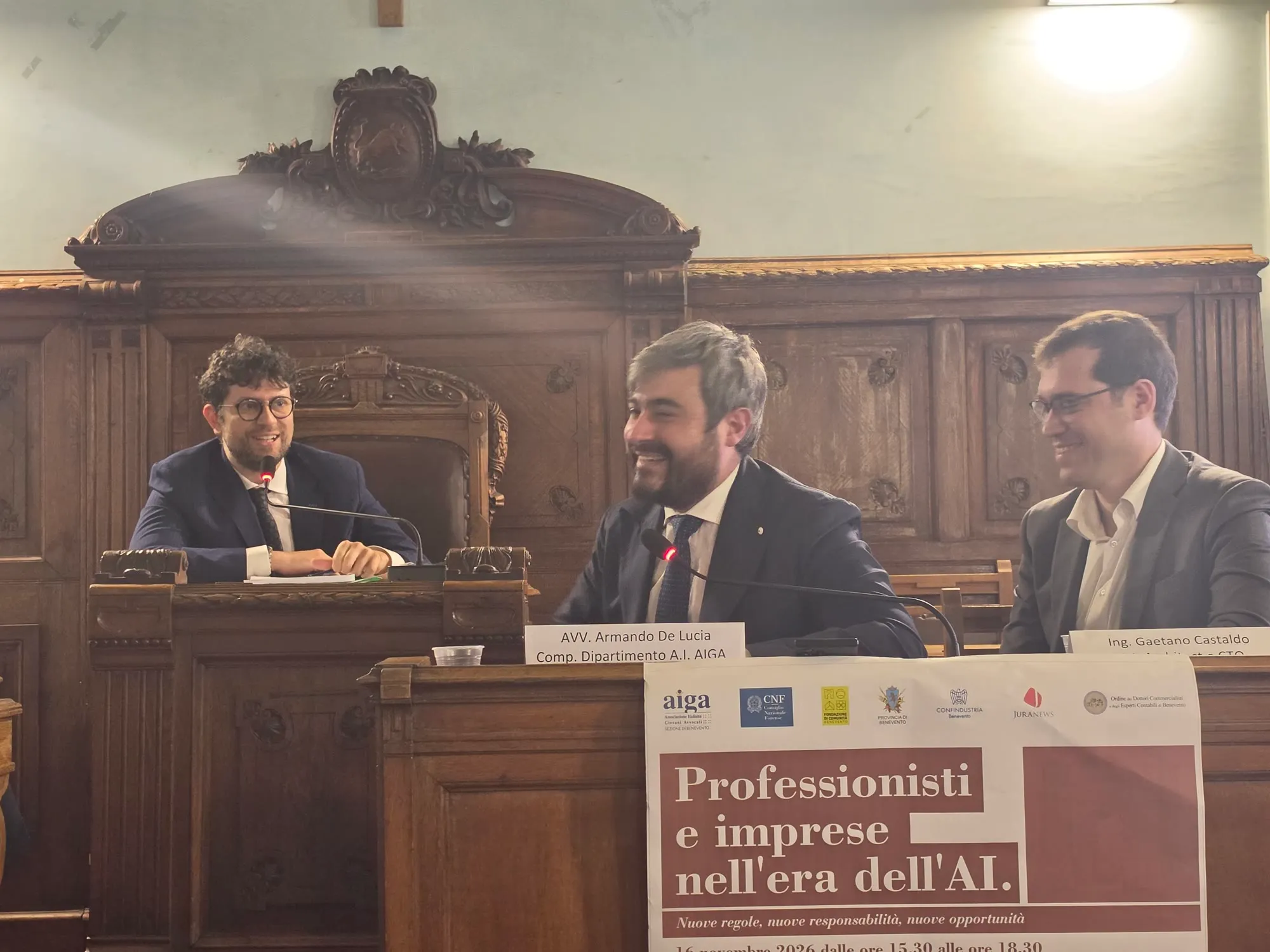
What changes when the same talk has thirty minutes?
The slides come from a single script, and a program generates a deck for each version. The technical part for Caserta has 42 slides, lab included, the one for Avellino 15, the one for Benevento 22. It is not the Avellino version stretched out: it is the Avellino version with seven slides put back in place.
Two of them are exactly the ones I had merged with others in Avellino: the shift from rules to probability and the comparison between chatbot and agent. The other five are about me, the history of law on computers, the rule on which data you can paste into a chat, why calling it an agent is not enough, and how much machine a firm needs.
The last one is the hardware table: a laptop with 8 GB of graphics card memory to try things out, a computer with 16-32 GB for a few people, a server with 128 GB for the whole firm. In Avellino I had removed it to fit into twenty minutes. In Benevento it came back, and out loud I added an order of magnitude: about 10,000 euros for a server for the whole firm.
What did the room ask?
The audience had been invited to ask questions during the talks as well, and the first one came straight from that figure. A participant picked up the 10,000 euro server and asked me whether, once it is in the office with the agent at work, it stays connected to the network.
The fear was precise: handing your mailbox to an agent means risking your own name under an email you never sent, if someone has tampered with the agent’s instructions. It is prompt injection described by someone who fears it, without needing the technical name.
It was the right question, and my slides did not have the tool to answer it. I had the slide on the trainee, with limited keys and nothing sent without a signature, but not the thing that enforces those keys.
How do you answer a question that is not in the slides?
By starting from what the room has just seen. The server is yours and you can connect it to whatever you like, but every process is handed to the agent with least privilege: if it works on the mailbox, it has no permission to send. And the protections inside a model can be removed, especially on an open model, so security has to sit around the model.
Then the concrete example: NVIDIA’s OpenShell, an open source enclosure in which each agent sees only the folders, addresses and credentials the firm has written in a policy, and everything else is blocked. For a lawyer it is granular control of the data: not a promise from the vendor, but a file the firm writes and can have audited.
More questions came on local AI and agent security, and the line stayed the same: for a law firm the main road is artificial intelligence running on a machine the firm owns, and until that machine exists, a professional plan with a contract. The free chat, never.
What do I take home?
That the hardware table, removed in Avellino to stay on time, came back in Benevento, and that is where the most useful question of the evening started.
The part for people who run a firm, meaning why local AI, how much the machine costs and how an agent’s enclosure works, is on the Castaldo Solutions website. This page stays backstage.