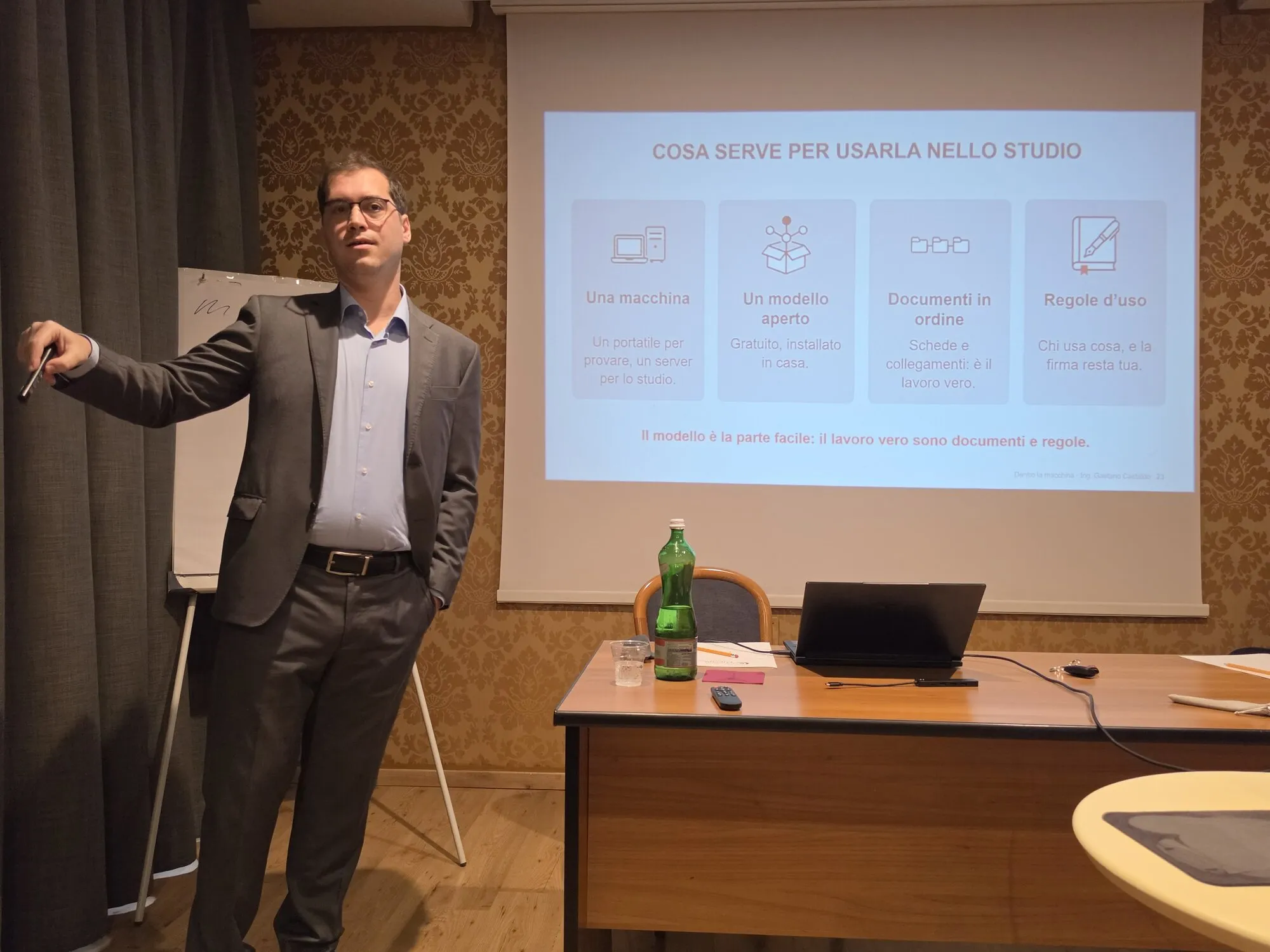
Why an engineer at a lab for lawyers?
Because since 23 October 2026 the training organised by Italian professional bodies has to include artificial intelligence from three angles: technical, legal and ethical. Article 47 of Legislative Decree 179/2026 says so. The first angle is my trade: explaining how the machine works to the people who answer for it.
Armando and I split the work as we do in our podcast, Innovazione Sotto Processo: I explain how a system is built and where it breaks, he explains who answers for it and how to protect yourself. For institutional events the terms were clear from the start: neutral slides, no logos, nothing commercial. In the room we talk about the machine, not about who sells it.
How do you prepare an AI demo that cannot count on the internet?
I set myself one rule: what the room sees has to run on the laptop in front of me, with no network. Otherwise "the data does not leave" stays a promise, not a proof.
The laptop has an 8 GB graphics card, and preparing the lab was an exercise in budgeting. The model, Qwen3.5 9B compressed to 4 bits, takes 5.2 GB; the conversation, up to about 16,000 word pieces, half a gigabyte. Measured on 8 November with a single chat open: 7,284 MB used, 673 free. With twice the conversation it no longer fit. That is why the whole archive does not go into the model: the model has to search it, which is exactly what I wanted to show.
The things that break, I found beforehand, and they are always the same:
- The card holds one model at a time. The first tests ran on Ollama, the archive on LM Studio: in between, a script frees the memory and reloads the model in about fifteen seconds, the time it takes to show the notes.
- LM Studio, opened from the editor’s terminal, closed as soon as it started because of an inherited environment variable. From the Start menu it did not. You only find out by testing on the real machine.
- After five or six questions the conversation fills up, and you open a new chat.
And for every live step there was a plan B: real screenshots of the tests, already in the slides. A demo that cannot fail does not exist. One that survives its own failure does.
Why did we build the archive of notes on Armando?
Because client data has no place in a public demo, and a fake archive convinces nobody. Armando volunteered: in the room he could confirm or correct every answer.
The archive is 64 notes in Obsidian, written only from public pages read on 8 November 2026: his website, his firm’s, the podcast, news of his talks. No social media, no contact details, no private life. Every note says which page it comes from, and a script checks that the 124 quoted sentences and the 214 numbers in the notes really appear on those pages. Today they all do.
In the tests, the most useful questions were the ones the archive cannot answer. Armando suggested one: whether he is registered on the state-funded legal aid lists. He is not, no page mentions it, and the model answered that the archive does not say. It also got something wrong: it wrote that Armando had promoted an event where he was only announced as a speaker. Since it cites the note behind every sentence, the error shows straight away.
Before searching, the model asks permission to use the tool that reads the archive, and someone has to click. I never ticked "always allow": the permission had to be visible every time, because it is the lawyer’s signature in miniature. In the room, asked what Armando means by "human in command", the answer came back with the notes cited one by one.
What do I take home?
Armando said the question he gets most often is which AI is the best. In the room he turned it around: "the decisive question is not which AI to use, but it is where to run it". It is what I had said about open and closed models, where the model runs and who sees the data, put in the words of the person who answers for it. To me it is the sign that splitting the work between technology and law works.
And I kept the Geoffrey Hinton story, because a lawyer needs it: one of the fathers of these networks told 60 Minutes in 2023 that we don’t really understand exactly how they do what they do. If he does not fully know, every answer has to be checked. It is not distrust of the machine: it is the method of people who work from sources.
The part for people who run a firm, with the three roads for the data, the legal obligations and what you need to start, is on the Castaldo Solutions website. This page stays backstage.