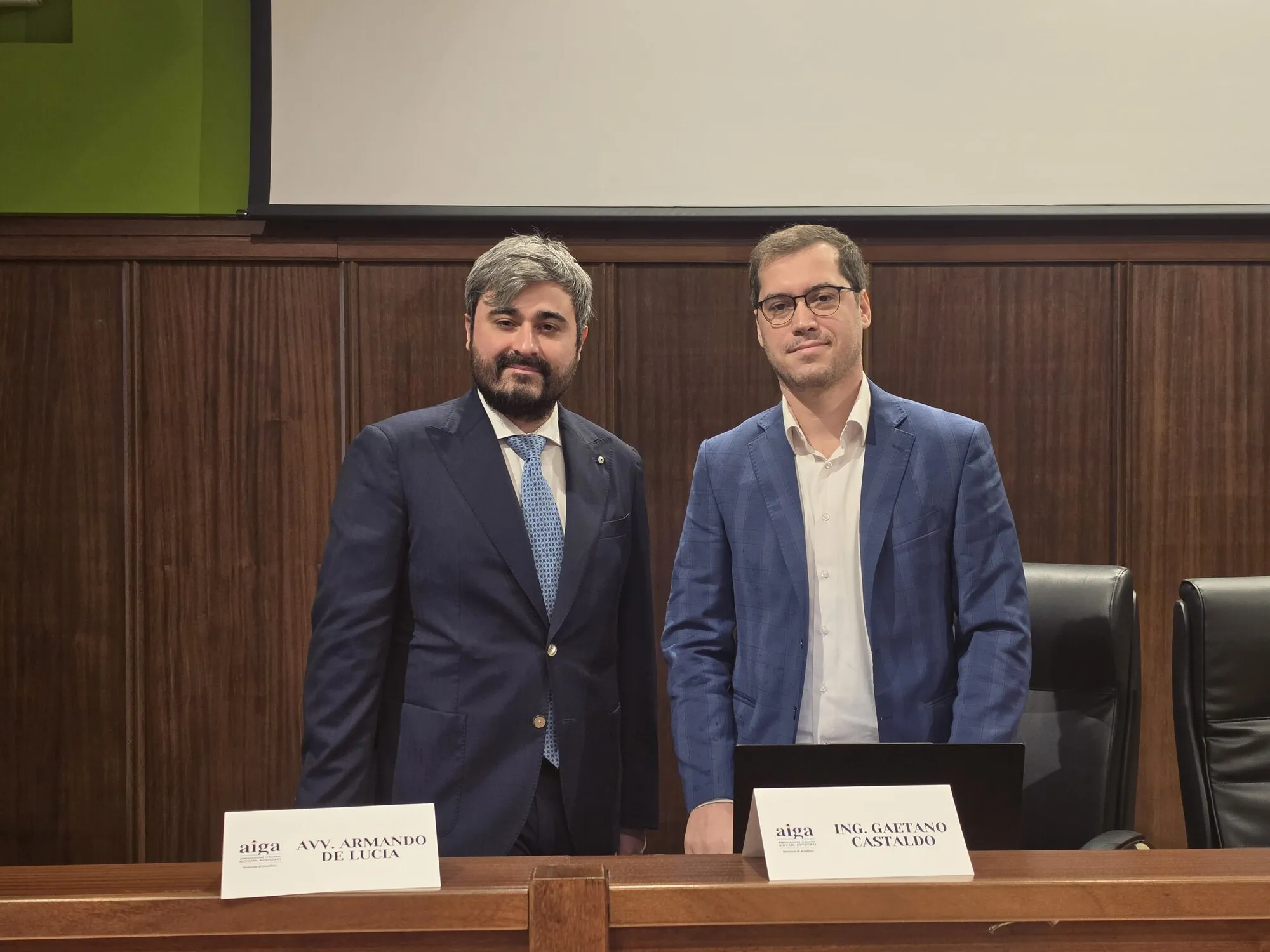
How do you fit a forty-minute talk into twenty?
Not by cutting slides by hand the night before. My talks for lawyers come from a single script: every slide declares which versions it belongs to, and a program generates the decks. The technical part for Caserta has 42 slides, lab included. The one for Avellino has 15.
The real cut, though, is not removing: it is making one slide do the work of two. In Avellino the slide on the most probable word also explains the shift from rules to probability, which in Caserta has a slide of its own. And the diagram of the agent, from the court email to the signature, also does the work of the chatbot versus agent comparison. What the slide no longer says, I say out loud, and it is written in the speaker notes: that way it does not depend on memory.
The writing rule is the same in every version: one idea per slide, the title within eight words, the body within thirty-five, and no term a lawyer would not use.
What did I remove, and what not?
I removed whatever needs time to be believed. The lab, first of all: the four tests on the offline laptop and the archive of notes built from Armando’s public pages stayed in Caserta. With them, the table on graphics card memory and the sizing of the machine a firm needs.
I kept the thread: where this technology comes from, how it reasons, where the data goes, what changes with an agent. Four questions, set out on the second slide, and no detours.
With no live test, the proof had to be in the slides. That is why every measurement carries the date I took it: the 64% for "ricorso" (appeal) after "Il giudice ha rigettato il…" (the judge dismissed the…) and the three different rulings for the same sentence are measurements from 8 November 2026, taken on a local open model. In front of a room of lawyers, a number without a date is an opinion.
Why agents, in front of a room of lawyers?
Because that is where the technical side and the legal side touch. As long as AI answers, the risk is a wrong answer. When it acts, meaning it opens the mail, adds to the calendar, prepares an email, the risk becomes a wrong action, and someone is responsible for an action. It is the point where I stop talking and Armando starts.
Many people know AI as a chat: you write to it and, like an oracle, it answers. So I started from the bottom, from the spam filter everyone has used for years without calling it artificial intelligence, and climbed one step at a time up to the agent. And I described my own work today: I have agents that use the computer for me, mouse included. It is already happening, and it will reach law firms in the next few years.
The last slide before handing over has no answers. It has three questions, made to be left hanging: who is responsible if the agent gets it wrong, how you inform the client, whether professional secrecy holds when the model is in the cloud.
What do I take home?
One sentence. My slide on the agent closes with "What must always be the same is done by a rule. The signature stays yours". The first half sits, as number three, among the seven rules for the firm that Armando presented in his part. He gets there from liability, I get there from the fact that a model does not compute: to me it is the sign that the two-voice format holds.
And one thing about the format: to me, in twenty minutes the talk felt quicker and sharper than the Caserta one.
The part for people who run a firm, with the agent diagram step by step and the seven rules, is on the Castaldo Solutions website. This page stays backstage.