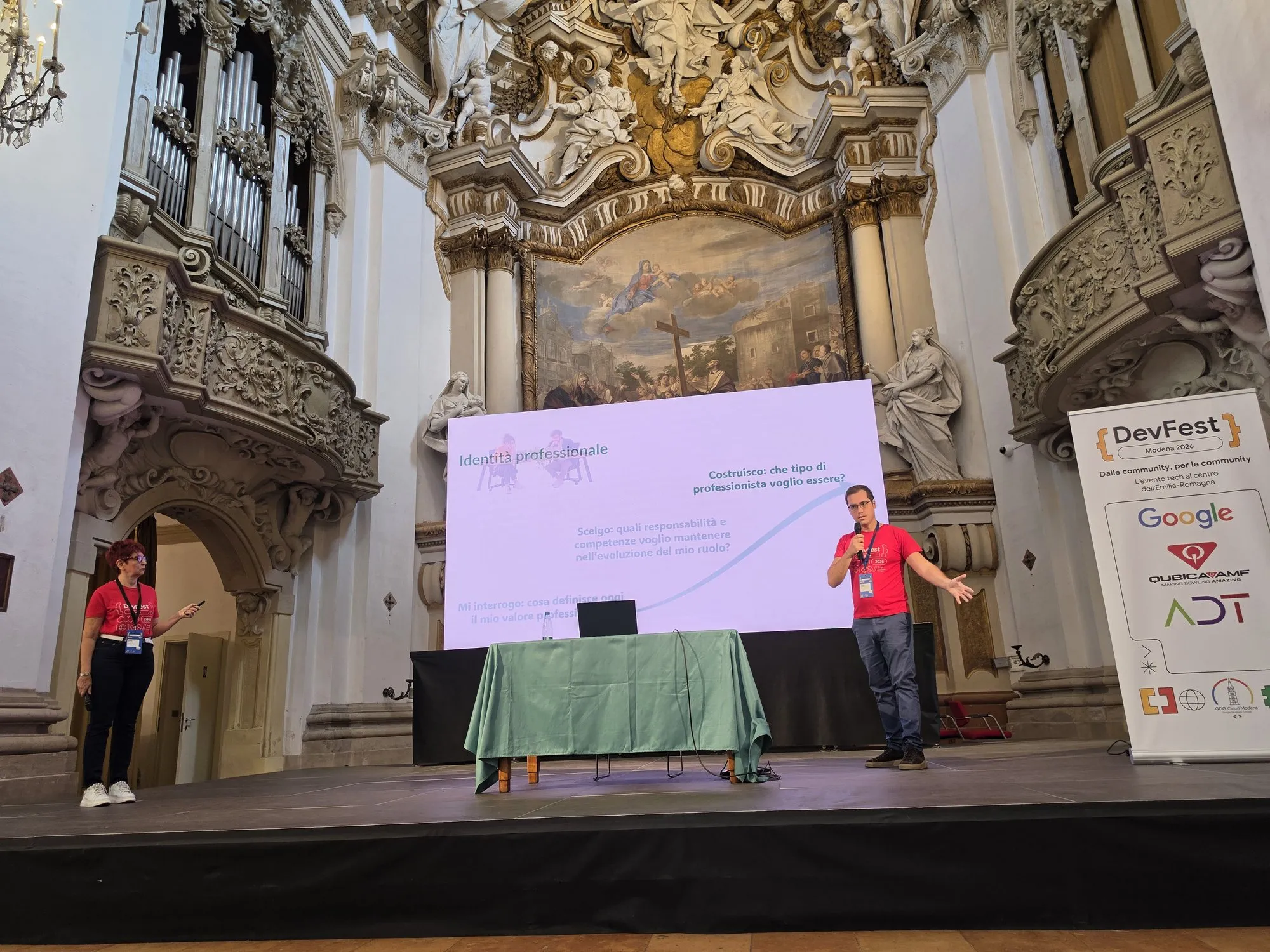
Why a talk about developers, and not about users?
Last year, from the same stage, Isabella had spoken to the people who build software about us users: when you put AI inside a tool other people use, you also take on part of the responsibility for how those people change. After the talk one of the organisers asked her a simple question: and what about us developers, are we not as human as the users?
That is where this work started. Developers are exposed to AI from two sides: they use it every day as a tool, and they build it into the products everyone else uses. Isabella works on how change affects people and never works on theory alone. On stage I was the side that lives those effects: we have been working together for more than a year.
Why does the brain not scale like a server?
I told the story of Isabella’s website, which I built. A site like that used to cost me 20 days of work. With AI, adding up the hours, development took two days. But the project did not take two days, and I do not now build ten sites a month: at best, I went from 20 days to 10.
The reason is two loads that AI does not compress. Cognitive load: what I used to digest over weeks has to be digested in a few days. And decision load: whether a button should be light blue, dark blue or green is something I decide over days, not minutes. The brain does not scale like a server, and we do not go as fast as an API.
Hence what we called the reliability paradox. The bottleneck used to be whoever produced, today it is whoever reviews, and it is the same person. Isabella read it with her own tools: when we have the resources to face a challenge we are in a state of safety. Under pressure, some people floor the accelerator, use AI everywhere and feel they are racing everyone, and others pull the handbrake and switch off.
What happens to a developer’s identity when AI writes the code?
For us technical people, skill is identity. A very good developer in one of my teams used to tell me: “I don’t know PHP, I am PHP.” When AI moves into exactly that space, the risk is no longer recognising yourself in your own work.
Anthropic measures the gap in research from March 2026: in computer and mathematical occupations AI could in theory cover 94% of tasks, but real Claude usage data shows it covering 33%. To me, what sits in between is decisions, and fear. A collaborator of mine, a developer I respect a lot, had to build a RAG agent on a new and poorly documented technology: in 20 days he wrote 250 lines of useful code, deleting and redoing. I asked him why he did not let AI run those attempts. He answered: “No. This is my job.”
Isabella read it this way: faced with the same stimulus you can withdraw, as he did, accelerate and let AI do everything without understanding, or redefine yourself.
On stage I gave my own answers to her three questions on identity. My value today lies in understanding processes, not just the class, the module or the library. What I want to keep is automation and continuous integration, and I can specialise in them by bringing AI into my own workflow: it is the job some companies are starting to call Forward Deployed Engineer, a role that even job descriptions cannot define well yet. And the professional I want to be is more tied to relationships. A developer used to be able to sit in a company’s basement writing their class in peace. Not anymore.
Where will seniors come from, if the questions go to AI?
Anthropic observed it in its own engineers, in a study from December 2025: Claude has become the first stop for questions that used to go to colleagues, and some report fewer mentorship opportunities. I saw it with a team of AI trainers I work with: 160 slides to review, I ask to do it together and I am told “I’ll have AI review them, we’ll meet at the end”. AI is powerful, but it does not beat the power of a real discussion.
You climbed the ladder from junior to senior by asking a colleague, getting your code reviewed, taking corrections from the senior. If those steps disappear, skill atrophy becomes measurable. In an Anthropic experiment from January 2026, 52 developers learned a new library: those who worked by hand scored 67% on the comprehension test, those who used AI 50%, with the widest gap on debugging. It has already been seen in doctors: in an observational study published in The Lancet Gastroenterology & Hepatology, endoscopists used to AI, back to working without it, found adenomas in 22.4% of colonoscopies against 28.4% before.
And the circle closes, in the words of the same Anthropic study of its engineers: supervising Claude requires the very coding skills that AI overuse may atrophy.
How do I train so I do not lose my skills?
These are rules I am imposing on myself, first of all:
- I do not use AI all the time. At some point I stop and try to do something on my own, to stay in shape.
- I delegate some modules, and not others.
- Every now and then I do the debugging myself.
It is not nostalgia. Checking AI’s work takes exactly the skills that AI makes you stop practising.